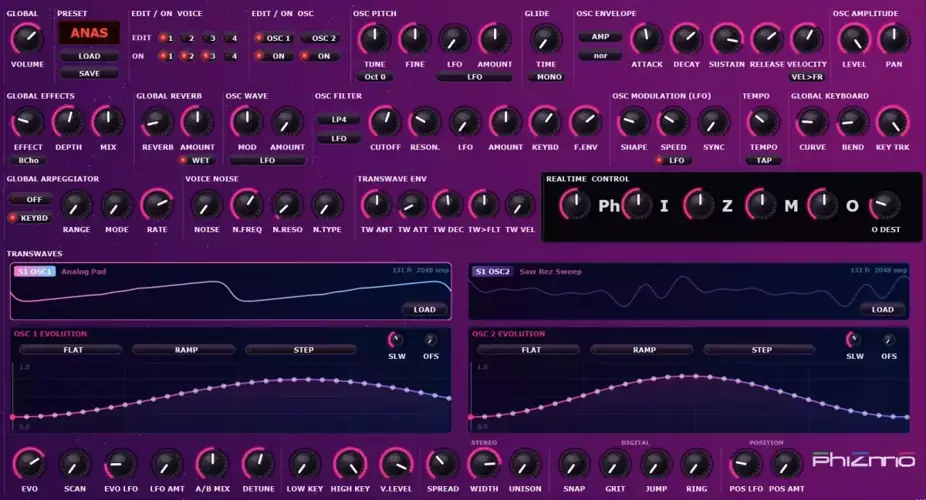
Phizmo
94 MB
Phizmo is a transwave / wavetable synthesizer inspired by the Ensoniq Fizmo. It closely emulates its behaviour, but is not a 1:1 clone. Phizmo scans through multi‑cycle wavetables (“transwaves”) along editable evolution curves, with two oscillators per voice, a full modulation set, an arpeggiator, per-voice insert effects and global reverb, and a set of
real‑time performance macros.
Phizmo looks for its content in your Documents folder. Create this structure and copy the files in as described in the download.
Presets in Documents/Phizmo/Presets show up in the LOAD browser and are where SAVE writes to.
Wavetables in Documents/Phizmo/Wavetables appear in the per‑oscillator LOAD menu (the little LOAD button inside each wavetable viewer). Presets already embed the wavetables they use, so a preset will load its sound even if the loose .wav isn’t installed, but you need the Wavetables folder if you want to load tables into oscillators yourself. You can also simply drag‑and‑drop a .wav straight onto a wavetable viewer, same for presets.
Voice vs. Oscillator (the core concept)
Phizmo has two levels of sounds, and the panel is labelled to make the scope of every control clear.
Voice (4 of them – the EDIT / ON VOICE row, top‑left)
A Voice is a complete layer/patch with its own keyboard zone. You can stack or split up to four Voices across the keyboard to build a single
sound. Each Voice has its own LOW KEY / HIGH KEY range, its own level, and its own full parameter set. (Internally the code calls a Voice a “Sound.”)
Oscillator (2 per Voice – the EDIT / ON OSC row)
Inside every Voice are two oscillators, OSC 1 and OSC 2. Each has its own transwave, evolution curve, tuning, pan, level and wave settings. Ring modulation and the A/B mix combine them.
So the full layout is 4 Voices × 2 Oscillators = up to 8 Transwaves playing simultaneously.
Every section title shows what it affects: GLOBAL, PER VOICE, OR PER OSCILLATOR.
EDIT buttons (1–4 for voices, OSC 1 / OSC 2 for oscillators) choose what the panel is editing right now. They don’t change the sound, they change what the knobs point at. ON buttons switch a Voice or an Oscillator in or out of the sound.
Transwaves & evolution (how the sound moves)
Each oscillator plays a transwave: a wavetable made of many single‑cycle frames. Instead of a static waveform, Phizmo scans through the frames
over time, which is what gives it its living, morphing character besides the unique tonal character of the transwaves themselves.
The evolution editor (the big graph under each wavetable viewer) is the path the scan follows. Draw the curve, or use FLAT / RAMP / STEP presets. EVO sets how fast the scan moves; SCAN sets the direction/style (forward, backward, ping‑pong, one‑shot…). The moving dot on the curve is the live playhead. STEP mode jumps frame‑to‑frame.
Credits
The whole concept of Transwaves and the design idea belongs to Ensoniq. The transwave wavetables and the preset names as well.
The code, the DSP engine, the GUI, the preset/wavetable system and all the fixes along the way, was written by Claude Opus 4.8, the AI by Anthropic, working from my direction across a series of conversations.


Aquanode.Phizmo ( 123 MB )