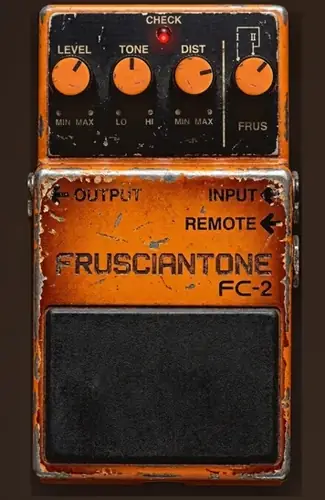
FC-2 TURBO
8.34 MB
Boss DS-2 style Distortion. A two-mode distortion modelled from a factory schematic, where the clipping diodes sit INSIDE the op-amp’s feedback loop – so they drop the loop gain instead of shearing the tops off your waveform. Solved as a circuit every single sample, not faked with a waveshaper curve.
In this circuit the clipping diodes are not sitting across the output shearing the tops off your waveform — they are wired inside the op-amp’s feedback path. As the signal grows, the diodes start conducting and the amplifier’s own gain falls away underneath it. The result compresses and blooms instead of squaring off, and it reacts to your picking hand, because how hard you hit it changes how much gain the circuit has.
That behaviour cannot be faked with a static curve, so it isn’t. FC-2 Turbo solves the clipper’s circuit equation once per sample, with the feedback capacitor and the supply rail both inside the solve, at 4x oversampling.
Mode I is the straight voice — mid-forward, still recognisably your guitar, happy in front of an amp that is already working.
Mode II is the turbo voice, and it is not mode I with more gain. A different network feeds the clipper and a different filter follows it. Measured on the shipping build, mode II carries 12.9 dB more 1 kHz-against-5 kHz tilt — that is the nasal, vocal, cutting quality, and it is why mode II sits forward in a busy mix at a level where mode I would vanish into it.
– Nineties alternative and grunge rhythm, where this kind of pedal was the sound rather than a boost into something else.
– Punk and pop-punk — mode II’s midrange is exactly the cut that survives a wall of cymbals.
– Stoner and desert rock, mode I into an already-driven amp.
– Noise rock and post-hardcore, mode II at high DIST, where the point is that it gets genuinely unpleasant.
– Anything that has to sit in a dense mix without needing its midrange EQ’d back in afterwards.
It is not only a guitar tool. It has teeth on bass, on a drum bus you want ugly, and on synth leads.
DIST, TONE, LEVEL, MODE. Save a sound by name from the top bar; a preset stores those four things and only those four — loading one will never switch the pedal off or resize your window. Preset files are plain XML on disk, so you can copy them between machines.
It is modelled from the schematic, not from an impression. Every block’s transfer function was derived by hand from the circuit and then checked against the compiled plugin. In the oversampled region the model tracks those derivations to 0.013 dB.
Every release has to pass the harness. 41 behavioural checks measured on the compiled plugin, plus 31 self-tests whose only job is to prove the measurement code can actually report a failure.
The oversampling factor was measured, not assumed. 4x, because on a deliberately nasty test tone it puts aliasing 28.8 dB down, and 8x buys another 9 dB there while buying nothing at all on an actual guitar note — where the floor is already 70 dB down.
Bypass is honest. The footswitch is also the host’s bypass parameter, so the panel and your DAW can never disagree, and the reported latency does not change when you stomp it — your track never shifts under you mid-take.
– Linear chain vs hand-derived transfer functions: 0.013 dB (oversampled region)
– Mode II extra 1 kHz / 5 kHz tilt: 12.93 dB measured vs 13.17 dB predicted
– THD across DIST 0 → 10: −16.7 → −11.2 dB, monotonic
– Aliasing, torture tone, 4x: 28.8 dB down
– Aliasing, open G, 4x: 70.4 dB down
– DC on the output, hot, both modes: below 0.001
– Stereo channels: bit-identical
– Bypassed latency: unchanged
What is not claimed: no physical unit was A/B’d against this plugin — there is no hardware here to compare with. It is voiced from the schematic and measured against itself, and every number above comes from the build you are downloading.
Features
– DIST / TONE / LEVEL / MODE, and nothing you have to learn.
– Two separate voicings, not a gain switch.
– Diodes-in-the-feedback-loop clipper, solved per sample at 4x oversampling.
– Named presets on disk, plain XML, voicing-only.
– Clickable footswitch bypass, also the host bypass parameter, latency-matched.
– Window sizes 50% / 75% / 100%.
– Photoreal pedal interface.


FC-2.Turbo.1.0.1 ( 8 MB )