SQ8L
30.3 MB
A faithful 64-bit port of SQ8L 0.91b, the free Ensoniq SQ-80 emulation by Siegfried Kullmann (2006–2008), for modern macOS (Apple Silicon and Intel), Windows x64 and Linux (x86-64 and ARM64), as VST2, VST3, Audio Unit (macOS), CLAP and LV2 (Linux).
SQ8L was a 32-bit Windows-only VST written in Delphi. Its source code was never released, and the plugin could no longer run in today’s 64-bit hosts. This project rebuilds it from the original binary so that it can keep being played.
The port was not written “by ear”: every part was translated from the original machine code and verified against the original plugin running inside an x86 emulator.
– Sound: bit-exact. The complete engine produces exactly the same samples as the original: 1176 test renders (all 168 factory programs × 7 MIDI scenarios: chords, legato, controllers, aftertouch, sustain, voice stealing, random sequences), 120.8 million samples per channel, zero differences. Each DSP module (DOC 5503 oscillators, filter, LFOs, envelopes, amplifier, voice management) was also verified call by call on real captured states — tens of millions of calls in total.
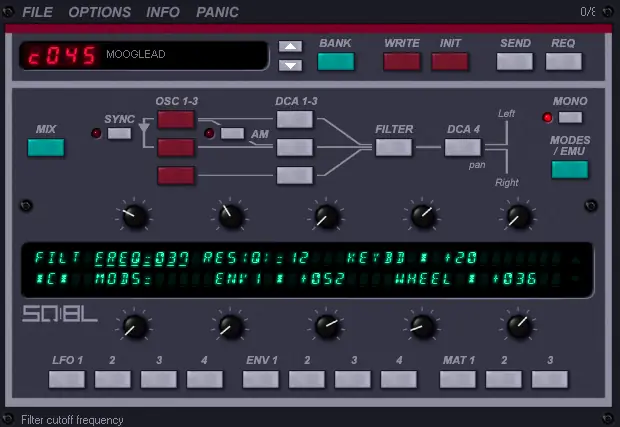
– Editor: pixel-exact. The window uses the original artwork and the original drawing logic: across 162 editor states, 0 differing pixels (text excepted, see below). The page and parameter logic was checked against the original in 26,705 interactions.
– Compatibility. Same VST2 unique ID (SQ8L), same 512 programs and the same chunk format as the original: projects saved with the original plugin load with their sound. Library files (.8XL), bank files and SQ-80/ESQ-1 SysEx are read and written exactly like the original.
– Popup menus, message boxes, file pickers and the WRITE / MIDI-port dialogs use the operating system’s native controls: on macOS they look like macOS. On Linux they are drawn inside the plug-in window (the file picker is the desktop’s, or a simple built-in one).
– A few small additions to the editor: a left click on the program number opens the program list (the original needs a right or double click), the VOICES parameter on the EMU page (see below), and these OPTIONS items: Polyphony (see below), Down arrow -> next program (the original’s hidden swapProgUpDn setting), Ask before loading banks/libraries (on by default, like the original), MTS-ESP (see below) and Zoom (see below). OPTIONS is also regrouped: Polyphony leads, and the original’s mouse-restore submenu and its separate Right click on display -> scroll page item are now one Mouse submenu.
– Window size: the editor can be enlarged from 100% to 300% with OPTIONS → Zoom (or the window’s corner, where the host allows it). It is drawn at the window’s resolution rather than enlarged: the panel (labels, signal lines, frames, logo) as vector shapes measured from the original’s picture, the knobs, buttons, LEDs and both displays from their state. The size is global (saved in SQ8L.ini).
– MTS-ESP: OPTIONS → MTS-ESP → Enable makes the plug-in follow an MTS-ESP master’s tuning, for microtuning and dynamic scales (off by default; the master’s scale name then appears in the top bar). Each voice is retuned by its own resampling clock rather than by the SQ-80’s pitch table, which is quantized to about 3 cents: the tuning is exact to a millionth of a cent while the oscillators, their relative detune and the sound itself are untouched. By default only the master’s deviation from equal temperament is applied, so the SQ-80’s own per-key pitch offsets (−1.5 to +0.5 cents, part of how it sounds) are preserved; Correct SQ-80 per-key pitch offsets tunes to the master’s frequencies exactly instead. Pitch bend and glide keep the original’s stepping either way. Both switches belong to the instance: they are saved with it in your project, not globally, so two instances can differ and a project recalls what it was set to.
– Polyphony: 8 voices like the SQ-80 by default, 1 to 64 with the VOICES parameter on the EMU page, right below VSTEAL. It belongs to the sound, so it is stored in the program and travels with it: into banks and libraries, and into the project your host saves. Every program that does not have it — anything made by the original SQ8L, any .8XL or bank file, any imported SysEx dump — plays with the SQ-80’s 8 voices, exactly as it always did, and the original can still load a bank the port saved. OPTIONS → Polyphony overrides the parameter for one instance (Set by program by default) and is saved with that instance in your project, not globally. Changing the voices never interrupts anything: the notes that are playing keep playing, and soft voice stealing gets as many slots to fade out in as there are voices. With 8 voices the sound is bit-exact; with more, a performance changes only where the original would have stolen a voice. The output is not rescaled, so many voices sounding together are louder: lower the volume if needed.
– Text (status bar, program name) uses Liberation Sans, a free font metrically compatible with Arial, with anti-aliasing.
– SEND/REQ to a hardware SQ-80/ESQ-1 over MIDI ports are not connected yet (SysEx import and export through files work).
– Two original bugs could not be reproduced and were made safe: an integer division by zero in the envelope SHAPE code for a few rare level/velocity combinations (the original crashed), and an uninitialised byte read in the “AM bug” emulation when oscillator 2 is edited while a note plays (the port uses the intended value).
– As in the original, sample rates below 44.1 kHz are not supported.


SQ8L.1.0.0 ( 30 MB )